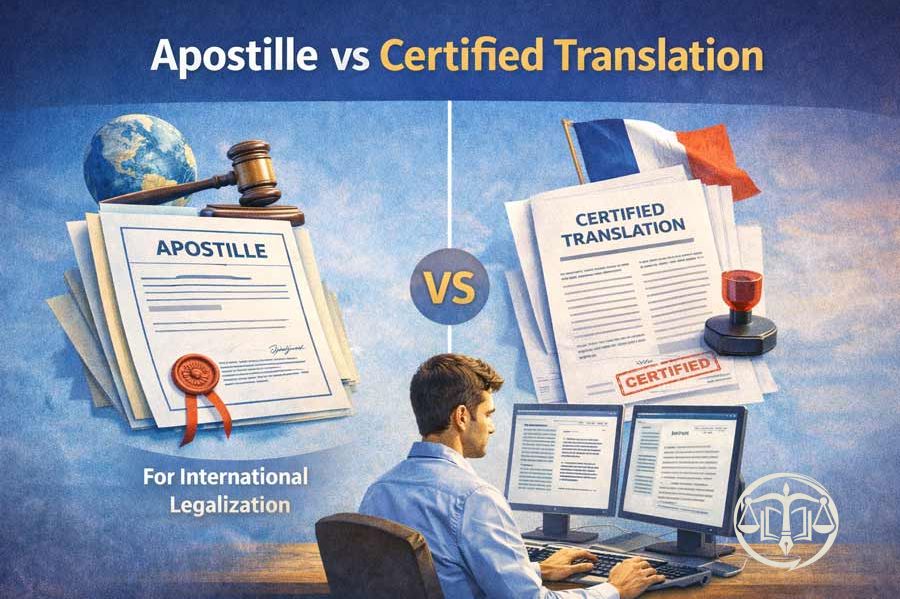
When dealing with international administrative, legal, or academic procedures, two concepts come up very often: the apostille and certified translation. Yet they are still widely confused by both individuals and professionals. This confusion can lead to mistakes, application delays, or even rejection by the authorities.
Understanding the difference between an apostille and a certified translation is essential if you want to complete procedures successfully abroad or in France. These two processes serve different purposes, but they are very often complementary. In this guide, we explain their role, when they are required, and why working with a professional translator is essential to secure your documents.
Apostille and certified translation: two different but complementary procedures
An apostille is an administrative formality used to certify the authenticity of a public document intended for use abroad. It was introduced by the 1961 Hague Convention to simplify the recognition of documents between signatory countries. In practical terms, it confirms that the signature, stamp, or seal placed on a document is genuine.
Certified translation, on the other hand, is an official translation carried out by an authorized translator. It certifies that the content of the document has been faithfully translated into another language.
The difference is therefore fundamental:
the apostille validates the authenticity of the document
certified translation guarantees understanding of the content
In most cases, these two procedures do not replace one another, but complement each other. A document may be authentic but impossible for a foreign administration to understand, or translated but not recognized as official. That is why it is common to need to apostille a document and then have it translated, or the reverse depending on the requirements of the country involved.
Why are these procedures essential in 2026?
As international mobility continues to grow, administrations have become more demanding about document validity and compliance. In 2026, French and foreign authorities apply strict rules to prevent document fraud and ensure the reliability of the information provided.
When a document is used in another country, it must meet two conditions:
be recognized as authentic
be understandable in the language of the destination country
This is exactly where the apostille and certified translation come in.
For example, a French birth certificate used abroad will often need to be apostilled to prove its authenticity, then translated so it can be understood. Conversely, a foreign document submitted in France will need to be translated, and sometimes legalized or apostilled depending on its origin.
The most common situations where apostille and translation are required
In practice, many procedures require one or both of these steps. The most common cases involve international administrative processes.
When applying for a residence permit in France, authorities often require foreign documents to be translated into French. If those documents come from another country, they may also need legalization or an apostille to be recognized.
For studies abroad, universities generally require diplomas that are both apostilled and translated. This makes it possible to verify both the authenticity of the document and the understanding of its academic content.
International marriages are also a classic example. Birth certificates must be authenticated to be recognized in another country, then translated so they can be understood by local authorities.
Professional procedures are no exception. Employment contracts, certificates, or references often need to be translated and sometimes legalized for use abroad.
Finally, in legal proceedings, even a minor inaccuracy can have significant consequences. Courts require documents to be translated officially and, in some cases, apostilled to guarantee their validity.
The central role of the translator in these procedures
Contrary to a common misconception, a certified translator does not simply translate text. Their role is far more strategic in the context of international procedures.
First, the translator ensures that the document is faithful to the original, with no omissions or incorrect interpretation. This precision is essential, especially for legal or administrative documents.
They also ensure terminological adaptation, using the appropriate legal or administrative equivalents in the target language. This helps avoid ambiguity and misunderstanding.
In the context of an apostille, the translator may be involved at different stages. They may translate a document before it is apostilled, or translate a document that has already been apostilled. In some cases, the translation itself may also need to be certified or recognized abroad.
Finally, the translator also plays an advisory role. They can guide the client on the steps to follow, the correct order of procedures, and the specific requirements depending on the country.
Common mistakes related to apostille and translation
Many people make mistakes that can slow down or compromise their procedures.
The first mistake is assuming that an apostille replaces translation. In reality, an apostilled document remains in its original language and may be rejected if it cannot be understood.
The second mistake is using a non-certified translation. Authorities require official translations, and a simple or machine translation has no legal value.
Another common mistake is failing to follow the correct order of procedures. Some countries require the document to be apostilled before translation, while others accept the reverse. The wrong process can lead to rejection.
Finally, document quality is essential. An illegible, incomplete, or poorly translated document may be rejected, even if it has been apostilled.
Why use a specialized platform like Legal Translation?
Given the complexity of these procedures, it is essential to rely on a dependable and specialized service.
Legal Translation is an agency specializing in the translation of official and legal documents, offering certified translations that comply with the requirements of French and international authorities.
One of its main advantages is its competitive pricing, with translations available from 20 euros per page. This positioning is made possible by a 100% online platform, with no intermediaries or subcontractors.
Unlike many competitors, Legal Translation connects clients directly with the translator. This improves quality, reduces turnaround times, and ensures a better understanding of each client’s needs.
The platform also provides a complete personal account area, allowing users to track requests, manage payments, access documents, and communicate with the translator.
Confidentiality is another key point. Documents are neither shared nor disclosed to third parties and benefit from a high level of security.
In terms of speed, Legal Translation offers optimized turnaround times, with fast processing suited to urgent administrative needs.
Finally, transparency is at the heart of the service. Prices, deadlines, and conditions are clearly stated, with no hidden fees.
How much do these procedures cost and how long do they take?
The cost of a certified translation depends on the type of document, its length, and the language pair. At Legal Translation, rates start from 20€ per page, making it an accessible solution.
The cost of an apostille, meanwhile, varies depending on the country and the competent authority.
In terms of timing, a certified translation can generally be completed within 24 to 72 hours, while an apostille may take anywhere from a few days to several weeks depending on the complexity of the file.
How to prepare your file effectively
To avoid mistakes and save time, it is important to prepare your documents carefully.
It is recommended to check the requirements of the country concerned in advance, especially regarding translation and legalization.
You should also make sure that the documents are complete, legible, and up to date.
Working with a professional translator from the start helps avoid mistakes and secure the entire process.
Apostille and translation: a strategic issue for your procedures
An apostille and certified translation are not just simple administrative formalities. They play a key role in the international validity of your documents.
A poor understanding of these procedures can lead to rejection, delays, or administrative complications.
On the other hand, a well-prepared process saves time, avoids mistakes, and ensures your file is compliant.
Conclusion
Do you have a question?
Can machine translation be used for an official document?
No. Machine translation tools have no legal value and are not accepted for administrative or legal procedures.
Why choose Legal Translation for a certified translation?
Legal Translation offers several advantages:
certified compliant translation
competitive prices starting at €20
100% online platform
direct contact with the translator
free quote in less than one hour
document confidentiality and security
full tracking through a client account
What is the difference between an apostille and a certified translation?
An apostille certifies the authenticity of a document (signature, origin), while a certified translation provides an official translation of its content. An apostille does not translate a document, and a translation does not replace an apostille. Both are often required for international procedures.
When is a certified translation required?
A certified translation is required as soon as a foreign document must be submitted to a French administration. This includes:
residence permit applications
naturalization
university applications
court proceedings
When does a document need an apostille?
An apostille is required when you use an official document in a foreign country that is a signatory to the Hague Convention. This applies in particular to:
civil status records
diplomas
court judgments
notarized documents
Should a document be translated before or after the apostille?
It depends on the country and the procedure. In general:
the document is apostilled first
then translated by a certified translator
In some cases, the translation itself may also need to be apostilled.
Do I need an apostille or a certified translation?
It depends on your situation. If you need to use a document abroad, an apostille may be required. If the document is in a foreign language, a certified translation is usually mandatory. In many cases, both are required.
How much does a certified translation cost?
The price depends on the document and language. With Legal Translation, certified translations start from €20 per page, with a free quote provided within one hour.
