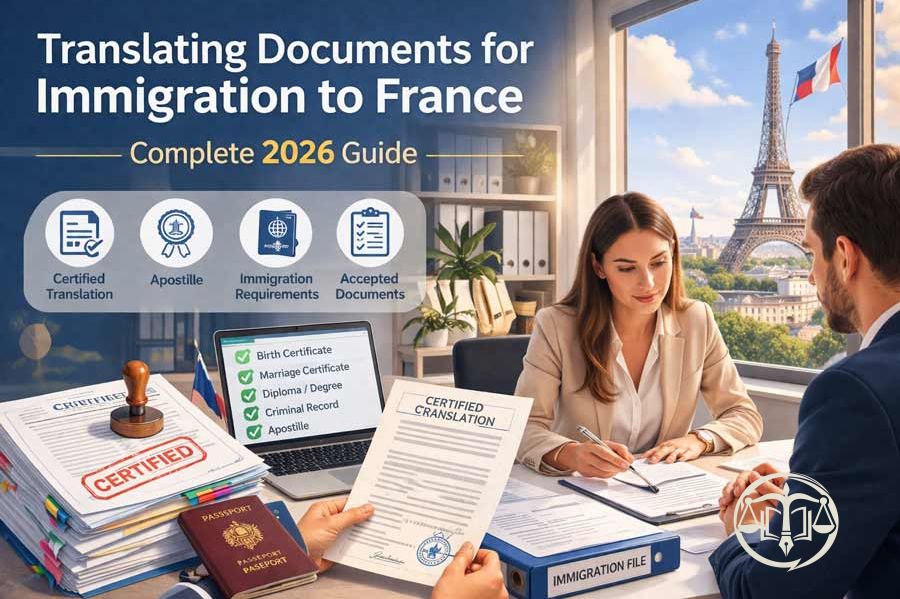
Immigrating to France involves many administrative steps, often complex and demanding. Among them, translating official documents is an essential requirement. Whether you are preparing a visa application, a naturalization request, a university enrollment file, or a family reunification case, the quality and compliance of your translations can make all the difference.
In this complete 2026 guide, we explain in detail how to translate your documents for immigration to France, the legal requirements involved, the difference between certified translation and apostille, and the key role of a specialized platform like Legal Translation.
Why translation is essential for immigration to France
French authorities require all documents written in a foreign language to be translated into French by a recognized translator. This applies in particular to:
- Birth certificates
- Diplomas and academic transcripts
- Marriage or divorce certificates
- Criminal records
- Employment contracts
- Financial documents
An incorrect or uncertified translation may lead to:
- Application rejection
- Major delays
- Requests for additional documents
In a strict administrative context, document compliance is critical. That is why it is important to understand the different types of translation that may be required.
Standard translation vs. certified translation: what is the difference?
Standard translation
A standard translation is completed by a translator without official recognition. It may be sufficient for informal use, but it is generally not accepted by French administrative authorities.
Certified translation
A certified translation is completed by a translator approved by a French Court of Appeal. This type of translation:
- Has legal value
- Is signed and stamped
- Certifies compliance with the original document
For most immigration procedures in France, a certified translation is almost always required.
Certified translation vs. apostille: do not confuse them
This is a very common source of confusion for applicants.
Certified translation
It concerns the content of the document. It guarantees that the text has been faithfully translated into French.
Apostille
An apostille concerns the authenticity of the original document. It is issued by a competent authority in the country of origin and certifies:
- The origin of the document
- The signature
- The official seal
👉 In short:
- Certified translation = compliant translation
- Apostille = international validation of the document
In many cases, both are needed for a complete immigration file.
Which documents must be translated to immigrate to France?
Depending on your situation (student, employee, family member, refugee), the documents to be translated may vary.
For a visa or residence permit
- Passport (sometimes partially translated)
- Birth certificate
- Proof of address
- Accommodation certificate
- Employment contract or job offer letter
For studies
- Diplomas
- Academic transcripts
- Training certificates
For naturalization
- Civil status records
- Criminal record
- Proof of financial resources
Each document must be translated accurately, without omission or interpretation.
French authority requirements in 2026
In 2026, French administrative authorities are increasingly strict about document quality.
Here are the main requirements:
- Translation completed by a certified translator
- Strict compliance with the original format
- Presence of stamp and signature
- Complete translation (no part omitted)
- Perfect readability
Digital platforms are also being used more and more, which requires high standards of security and traceability.
Mistakes to avoid when translating documents
Many applications are rejected because of avoidable mistakes:
- Using automatic tools without human review
- Choosing a non-certified translator
- Submitting incomplete documents
- Overlooking legal mentions
- Confusing translation with legalization
A single mistake can delay your plans by several weeks or even months.
Why choose a specialized platform like Legal Translation
When reliability is essential, using a specialized platform offers many advantages.
Certified translation starting at €20 per page
Legal Translation offers highly competitive pricing, starting at 20 euros per page, while guaranteeing professional quality.
A no-middleman model
Unlike many competitors:
- No opaque subcontracting
- No intermediaries
- Direct connection with the translator
The result: better quality control and lower prices.
A 100% online platform for greater simplicity
Legal Translation stands out through its fully digital process:
- Online document upload
- Real-time tracking
- Secure payment
- Direct communication with the translator
This model allows for:
- Significant time savings
- Lower costs
- A smooth, modern experience
A complete and professional client account
The platform provides a personal account area that allows you to:
- Track translation requests
- Manage payments
- Access invoices
- Manage your profile
- Use integrated messaging
This account area is especially useful for:
- Students
- Professionals
- Law firms
- Businesses
Data confidentiality and security: a major issue
In immigration matters, documents are often sensitive:
- Personal data
- Financial information
- Legal documents
Legal Translation guarantees:
- Total confidentiality
- No sharing with third parties
- Enhanced security
- Data integrity
Unlike some platforms, your documents remain strictly protected.
Fast turnaround: a key factor
Administrative deadlines are often tight. Legal Translation offers:
- Fast turnaround times
- Immediate handling
- Optimized delivery
This speed is made possible by:
- A digital platform
- Direct coordination with translators
- Smart automation
Full transparency for a trusted relationship
Legal Translation is built on maximum transparency:
- Clear prices with no surprises
- Detailed tracking
- Direct communication
- A visible process at every stage
This transparency is essential for building trust with clients.
How does a translation with Legal Translation work?
Here are the simple steps:
- Upload your document to the platform
- Review and assignment to a certified translator
- Certified translation
- Validation
- Digital delivery (and/or physical delivery if needed)
The entire process is designed to be fast, secure, and efficient.
Practical tips for a successful immigration file
To maximize your chances:
- Plan your document translations in advance
- Check the specific requirements of the authority involved
- Prepare clear, readable copies
- Use a certified service
- Verify whether an apostille is required
Good preparation can help you avoid many problems.
Conclusion: a key partner for your 2026 procedures
Translating documents for immigration to France is a crucial step that should not be taken lightly. Between strict administrative requirements, the need for legal compliance, and tight deadlines, it is essential to rely on a trustworthy partner.
Legal Translation positions itself as a modern, affordable, and secure solution, offering:
- Certified translations
- A 100% online platform
- A direct relationship with translators
- Total confidentiality
- Maximum transparency
Whether you are a student, a professional, or applying for naturalization, choosing the right translation service can make all the difference to the success of your plans in France.
Do you have a question?
How do I know if I need an apostille?
It depends on the country of use.
👉 If your destination country is a member of the Hague Convention, an apostille is generally required to validate your documents internationally.
Is certified translation required to immigrate to France?
Yes, in most cases. French authorities require certified translations for all documents written in a foreign language, including civil status documents, diplomas, and official records.
Is a sworn translation valid throughout France?
Yes. A translation completed by a sworn translator registered with a French Court of Appeal is valid throughout the country.
How long does a certified translation take?
Turnaround time depends on the volume of documents, but an online platform generally allows for fast processing, often within just a few days.
Which documents need to be translated for a visa or residence permit?
The most common documents are:
- Birth certificate
- Marriage certificate
- Diplomas and transcripts
- Criminal record certificate
- Employment contract
Each application may vary depending on your situation.
Will my documents remain confidential?
Yes. A professional platform guarantees:
- Data protection
- No sharing with third parties
- Enhanced security
Confidentiality is essential for legal and administrative documents.
Why choose an online translation platform?
An online platform like Legal Translation offers:
- Fast turnaround times
- Competitive pricing
- Real-time order tracking
- Direct communication with translators
👉 It is a modern, efficient solution идеально suited for immigration and administrative procedures.
Can I use machine translation for official documents?
No. Machine translations (such as Google Translate) are not accepted by French authorities. Only certified translations performed by sworn translators have legal value.
How much does a certified translation cost?
The price depends on the document type and complexity.
👉 With Legal Translation, prices start from €20 per page, making it a highly competitive option.
