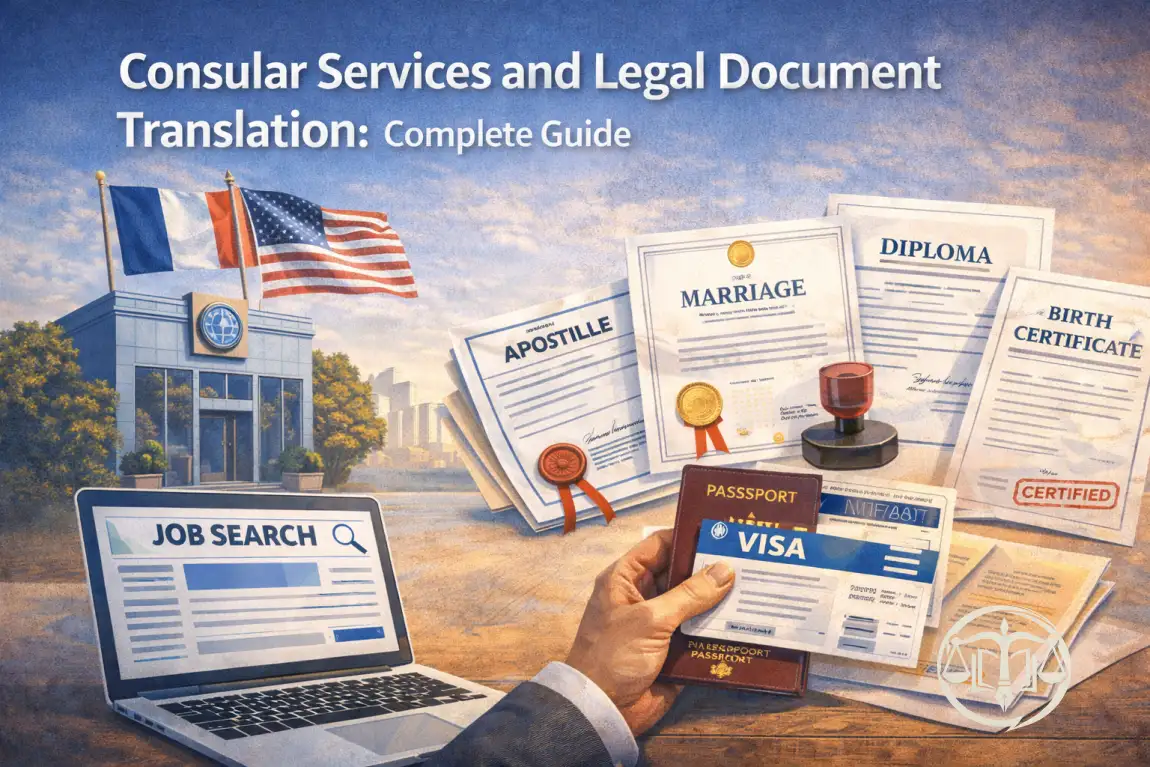
When your plans take you across borders—whether for marriage, studies, starting a business, or relocating abroad—you inevitably enter the world of consular services and legal translation. This duo is the administrative cornerstone that validates your identity and official documents for use abroad. This guide explains how they work together and how to navigate this complex process successfully.
The role and responsibilities of consular services
An embassy or consulate is not just a diplomatic representation. For citizens and residents, it is an administrative office abroad. Its main responsibilities include:
- Civil status matters: Registration of births, marriages, and deaths of nationals abroad.
- Issuing documents: Passports, national identity cards, certificates of nationality.
- Assistance and protection: Support for nationals in difficulty (lost documents, accidents, crises).
- Legalization: A key step that authenticates the signature and seal on a foreign public document (or a translator's signature) so that it can be accepted in the destination country.
Important note: A consulate does not translate your documents. It legalizes or certifies a copy of a document (original or already translated), confirming the authenticity of the signature and the status of the signing authority.
Legal translation: much more than a simple translation
A legal translation (or certified/sworn translation) gives a translated document legal and evidentiary value. It is essential when you need to submit a personal or official document to a foreign authority.
- Who can provide it? A sworn translator (or court-approved expert translator in France, "sworn translator" in some English-speaking contexts, "traductor jurado" in Spain). This professional is authorized by a judicial or state authority and bears legal responsibility for the translation.
- Why it is non-negotiable: A machine translation or uncertified translation will be systematically rejected by a consulate, university, court, or prefecture. Only the signature and seal of a sworn or certified translator provide the required authenticity.
Documents commonly concerned:
- Civil status documents: Birth, marriage, and death certificates, family record books.
- Legal documents: Judgments, contracts, articles of incorporation, powers of attorney.
- Academic documents: Diplomas, transcripts, certificates.
- Administrative documents: Criminal record extracts, proof of residence, commercial register extracts.
Practical tips for a smooth process
- Plan well in advance: The time needed to get a consular appointment, a sworn translation, and an apostille can stretch over several weeks.
- Check official sources: Each consulate has its own rules. Visit its official website section dedicated to citizen services.
- Choose the right translator: Make sure the translator is properly sworn or certified and, ideally, familiar with the requirements of the destination country. Ask for references or a sample of their stamp/signature.
- Prepare copies: Always provide the translator with a clear copy of your original document. Never mail your only original without first making a scan.
- Check consistency: Names, dates, and places must match perfectly across all documents (passport, original, translation).
Frequently asked questions (FAQ)
- Can I translate my diploma myself and have it certified? No. Certification applies to the translator's signature, not to the quality of a self-made translation. It must be done by an authorized professional.
- Does my French birth certificate need an apostille to be used in Germany? Yes. France and Germany are members of the Hague Convention. You will need an apostille on the original French certificate, then have it translated by a sworn translator in Germany (or in some cases, translated in France and have the translation apostilled—this should be verified).
- Can my country's consulate recommend a translator? Often, yes. Consulates frequently maintain a list of sworn translators working within their jurisdiction.
Conclusion: An essential partnership
Consular services and legal translation form an inseparable process for any official procedure abroad. By understanding the role of each one—the consulate that authenticates, and the translator who renders the document with legal validity—and by following the process step by step, you can turn administrative complexity into a manageable formality. The key to success lies in choosing recognized professionals and planning timelines carefully.
