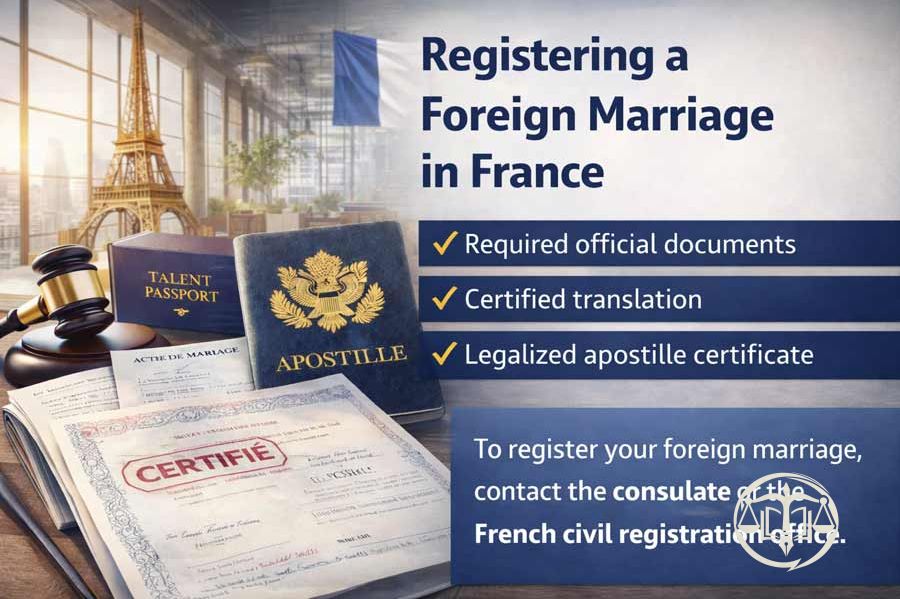
Transcribing a foreign marriage contract in France is an essential step in having your union legally recognized in France. Whether you are a French-foreign couple or two foreign nationals living in France, this administrative process requires full document compliance, especially when it comes to legal translation.
In this complete 2026 guide, we explain in detail the steps to follow, the legal requirements, the mistakes to avoid, and the key role of certified translation and the apostille in validating your application.
What is the transcription of a foreign marriage contract?
Transcription means registering a marriage celebrated abroad in the French civil status registers. This process makes the marriage legally valid in France.
It is generally carried out through the Central Civil Status Office or the French consulate in the country where the marriage took place.
è Without transcription:
- The marriage is not officially recognized in France
- It may be impossible to assert certain rights such as inheritance, tax benefits, or spousal protection
Why is transcription required in France?
France requires foreign civil status records to comply with French standards in order to be recognized. This helps to:
- Guarantee the authenticity of the marriage
- Verify the legal validity of the union
- Ensure consistency with French law
This procedure is especially important in the following cases:
- Mixed marriage (French national + foreign national)
- Moving to France
- Citizenship application
- Administrative procedures (family benefits, health insurance, etc.)
What documents are required for transcription?
The file may vary depending on the situation, but the most commonly requested documents are:
- Foreign marriage certificate
- Marriage contract (if applicable)
- Birth certificates of both spouses
- Identity documents
- Proof of French nationality (where applicable)
è All documents written in a foreign language must be translated into French by a certified translator.
Certified translation: an essential step
Certified translation is required to ensure the compliance of foreign documents.
It must be carried out by an approved translator, who certifies that the translation is faithful to the original.
Why is it required?
- To ensure French authorities can understand the documents
- To guarantee the legal value of the document
- To avoid any incorrect interpretation
è A non-certified translation often leads to the application being rejected.
Apostille: what is it for?
An apostille is an official certification that confirms the authenticity of a foreign document.
It is issued by a competent authority in the country of origin.
Its role:
- Verify the signature
- Authenticate the document
- Allow it to be used abroad
Certified translation vs. apostille: understanding the difference
This is a very common source of confusion.
- Certified translation concerns the content of the document
- The apostille concerns the authenticity of the document
è In most cases:
- You need both
The steps of transcription in 2026
1. Prepare the documents
Gather all the required documents and check that they are valid.
2. Have the documents translated
Use a professional service to obtain certified translations.
3. Have the documents apostilled (if necessary)
Depending on the country of origin, this step may be mandatory.
4. Submit the application
To the consulate or the Central Civil Status Office.
5. Wait for approval
Processing times can range from a few weeks to several months.
Common mistakes to avoid
Non-compliant translation
An incorrect translation can lead to immediate rejection.
Forgetting the apostille
Some applications are rejected because the original document was not properly certified.
Incomplete documents
An incomplete file can significantly delay the process.
Misunderstanding the requirements
Each situation may involve specific requirements.
Legal Translation's key role in your process
In this complex context, Legal Translation supports you at every stage.
Certified translation from €20 per page
Competitive, accessible, and transparent pricing.
A 100% online platform with no intermediaries
- No subcontracting
- Direct contact with the translator
- Higher quality
Full translation compliance
Every translation is:
- Compliant
- Certified
- Accepted by administrative authorities
Comprehensive support
Legal Translation helps you with:
- Administrative procedures
- Legal files
- Academic procedures
A professional client area
- Request tracking
- Online payment
- Access to invoices
- Messaging
Confidentiality and security
Your documents are:
- Protected
- Not shared
- Secure
Speed and efficiency
- Fast turnaround
- Optimized processing
- Efficient delivery
Full transparency
- Clear pricing
- Real-time tracking
- Direct communication
Practical tips for a successful transcription
- Plan ahead
- Check the consulate's requirements
- Use a certified translator
- Prepare legible copies
- Check whether an apostille is required
How long does transcription take?
Processing times vary depending on:
- The country of origin
- The complexity of the application
- Administrative workload
è On average:
- A few weeks to several months
Conclusion: secure your process in 2026
Transcribing a foreign marriage contract in France is an essential step in having your union officially recognized.
Between administrative requirements, certified translation, and the apostille, it is crucial to leave no room for error.
Legal Translation offers a reliable, fast, and secure solution to ensure your documents are compliant and maximize your chances of success.
è In 2026, choose a digital, transparent, and professional solution to simplify your procedures and move forward with peace of mind in your life project in France.
Do you have a question?
Why choose Legal Translation for the transcription of your foreign marriage?
The success of your marriage transcription largely depends on the quality and compliance of your translations.
Legal Translation offers a complete and optimized solution for your administrative procedures:
- ✅ Certified sworn translation from €20 per page
- ✅ 100% online platform with no intermediaries
- ✅ Direct contact with the translator
- ✅ Documents accepted by French authorities
- ✅ Total confidentiality and secure data handling
- ✅ Real-time tracking through a professional customer dashboard
Unlike many services, Legal Translation guarantees full transparency and fast processing, making it perfectly suited to administrative procedures such as marriage transcription.
👉 By choosing a reliable platform, you:
- Save time
- Avoid costly mistakes
- Increase your chances of approval
How do you register a foreign marriage contract in France step by step?
Registering a foreign marriage contract in France is an essential administrative procedure to have your union legally recognized in France. It involves recording a marriage celebrated abroad in the French civil status registers.
The process generally takes place in several steps:
- Gather the required documents: foreign marriage certificate, marriage contract, birth certificates, and identity documents.
- Have the documents translated: all foreign-language documents must be translated into French by a sworn translator.
- Obtain an apostille if required: depending on the country of origin, this certification may be mandatory to validate the documents.
- Submit the file: to the French consulate or the Central Civil Status Office.
- Wait for approval: processing times range from a few weeks to several months.
👉 To avoid rejection, it is essential to provide perfectly compliant documents and accurate translations from the start.
What is the difference between a certified translation and an apostille for a foreign marriage?
This is a very common and essential question when preparing a valid file.
A certified translation is carried out by an approved translator and certifies that the content of the document is faithful to the original. It is mandatory so that French authorities can understand and accept your documents.
An apostille, by contrast, is an official certification attached to the original document. It confirms its authenticity, including the signature, stamp, and origin.
👉 In practice:
- Certified translation = validity of the content
- Apostille = validity of the document
In most marriage transcription procedures in France, both are required to ensure a complete and compliant file.
What are the processing times and rejection risks for a foreign marriage transcription?
Processing times for marriage transcription vary depending on several factors:
- The country where the marriage was celebrated
- The complexity of the case
- The workload of the administrations involved
👉 On average:
- Between 1 and 6 months, and sometimes longer
However, many files are delayed or rejected بسبب avoidable mistakes:
- Non-certified translations
- Incomplete documents
- Missing apostille
- Inconsistencies in the information
👉 Even a minor detail can lead to:
- A request for additional documents
- Rejection of the application
- Several months of delay
That is why it is strongly recommended to use a professional service to secure your application from the outset.
