Do you have a question?
Why choose online legal translation instead of a traditional agency?
Modern legal translation platforms like Legal Translation offer major advantages over traditional agencies.
Unlike conventional agencies, which often rely on intermediaries or subcontracting, a 100% online platform connects you directly with the translator. This ensures higher quality, greater transparency, and lower costs.
The main benefits include:
- Competitive pricing (from €20 per page)
- Faster turnaround times
- Real-time order tracking
- Direct communication with the translator
- A complete customer dashboard (payments, invoices, messaging)
In addition, digital platforms offer a high level of security to protect sensitive information.
👉 The result: a more modern, more efficient solution perfectly suited to today’s needs, including immigration, legal, and academic procedures.
What is the difference between legal translation, certified translation, and an apostille?
Legal translation refers to the translation of law-related documents such as contracts, judgments, company bylaws, and official records. It requires excellent command of legal terminology and legal systems.
Certified translation, by contrast, is performed by a sworn translator approved by a Court of Appeal. It has legal value and is required by administrations for official documents such as birth certificates and diplomas. It generally includes a stamp, signature, and certification statement.
An apostille is different again: it does not concern the translation itself, but the authenticity of the original document. Issued by a competent authority, it certifies that the document is official and can be recognized abroad.
👉 In short:
- Legal translation = the type of content
- Certified translation = the legal validity of the translation
- Apostille = validation of the original document
In many cases, especially for immigration, studies, or legal procedures, all three may be required to ensure full compliance.
Why can a legal translation error have serious consequences?
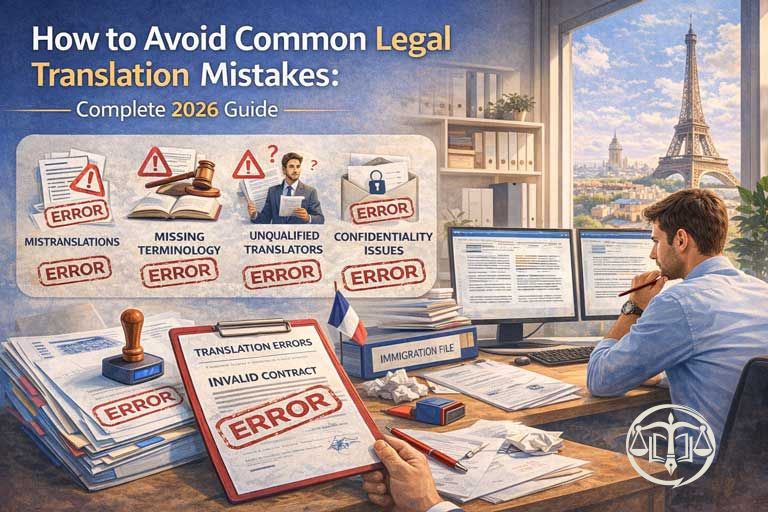
A legal translation error can change the meaning of a document and lead to significant, sometimes irreversible, consequences.
Unlike general translation, every word in law carries precise meaning. For example, a mistranslation of a contractual term can alter one party’s obligations or create a legal imbalance.
The consequences may include:
- Rejection of an administrative application (immigration, visa, naturalization)
- Invalidation of a contract
- Legal disputes or conflicts
- Major financial losses
In some cases, even a small translation mistake may be used legally by the opposing party.
👉 That is why it is essential to work with a specialized or sworn translator who can guarantee an accurate, faithful, and legally compliant translation.
How can I guarantee the confidentiality and compliance of my legal documents?
Confidentiality is a major concern in legal translation because the documents involved often contain sensitive information such as personal data, contracts, financial records, or administrative files.
A professional platform like Legal Translation applies several levels of protection:
- Secure data handling and communications
- Restricted access to documents
- No sharing with third parties
- Secure storage
- Preservation of file integrity
At the same time, compliance is ensured through:
- The involvement of qualified or sworn translators
- Strict respect for the original document
- Inclusion of all mandatory legal statements
- Validation before delivery
👉 By choosing a reliable service, you not only protect your information but also ensure that your documents will be accepted by the relevant authorities or institutions.
