Certified translation of a family record book for use in France
Order a certified translation of a family record book online for 20 EUR. Upload all completed pages and receive a translation by a human translator.
Choose the language combination and priority.
Add your instructions and the appropriate delivery method.
Review the estimated price, then add your documents.

The summary updates according to urgency and delivery method.
A more focused page to better distinguish each request.
Select the options that affect turnaround time, delivery method, and the estimated amount.
Certified translation of a family record book is commonly requested when a French livret de famille must be used abroad or when a foreign family record book, family booklet, or equivalent civil status document must be presented to an authority in France. In practice, this often concerns immigration files, nationality applications, inheritance matters, school enrollment, or benefit claims. On Legal Translation, you upload the complete document, receive a fixed quote of 20 EUR online, and one human certified translator prepares the translation. Because requirements vary by authority, you should always check the exact formalities requested by the office that will receive your file.
What a family record book translation is
In France, the livret de famille is a civil status document that brings together key family events such as marriage, birth, filiation, adoption, divorce, and death, together with later notes added by the civil registry. When this document is used outside its original language, the receiving authority may ask for a certified translation so that the information can be read and assessed in a formal context.
A translation of a family record book is not limited to the main entries. All completed pages should be translated, including marginal notes, handwritten entries, stamps, and later annotations. This is important because the value of the document often lies precisely in those updates: recognition of a child, divorce references, changes of name, or other civil status mentions recorded after the original issue.
For French administrative procedures, the family record book is often relevant because it summarizes family relationships. The French public service website explains the purpose and content of the livret de famille, including the events that may appear in it. That helps applicants understand why a receiving authority may want a full translation rather than selected extracts only.
When this translation is commonly needed
This translation is commonly requested in a wide range of situations involving French authorities, consular services, or private professionals who need to review family status documents. In cross-border cases, it may concern either a French family record book to be used abroad or a foreign equivalent to be submitted in France.
One frequent case is family immigration or family reunification. When a file is reviewed by the prefecture or by the French Office for Immigration and Integration, the authority may ask for civil status documents that clearly establish family ties. The official page on family reunification in France gives an overview of this process and the supporting documents that may be relevant depending on the case.
Another common use is naturalization or nationality-related procedures, where the applicant must document identity, marriage, children, and filiation. Family record book translations may also be included in inheritance or succession matters handled by a notary, especially when heirs live in different countries or when family events were registered abroad.
This document is also frequently used for day-to-day administrative formalities. Parents may need it for school registration, consular procedures, or applications involving French family benefits. For example, the French benefits system provides information about family-related support such as the complément familial, and some cases require supporting civil status records. Whether a translation is needed depends on the language of the document and the requirements of the body examining the application.
If you are presenting a foreign family booklet or a set of equivalent civil status pages in France, the receiving authority may ask for a French certified translation. If you are using a French livret de famille outside France, the foreign authority may request a certified translation into its own language. In both cases, the safest approach is to check the list of accepted formats directly with the authority or professional receiving the document.
Who can produce this translation in the United States
For readers in the United States, the usual term is certified translation. In U.S. practice, a certified translation is generally a complete translation accompanied by a signed statement from the translator or translation provider confirming that the translation is accurate and complete to the best of their knowledge and ability. Requirements can differ from one authority to another, so the terminology used in France, such as traduction assermentée, should not automatically be treated as identical in every U.S. context.
When the translated family record book is intended for a French prefecture, OFII office, CAF, consulate, or notary, the receiving body may request a translation that meets French administrative expectations. French authorities sometimes require a translation prepared by a translator recognized for official purposes in the country where the translation will be used, or they may ask for a translation done in France by a court-approved translator. The page on supporting documents for applications submitted to French authorities abroad notes that foreign-language documents may need translation depending on the procedure.
For that reason, it is important to verify in advance who is accepted in your specific case. The answer may depend on whether your document will be submitted in France, to a French consulate, or to a non-French authority. Legal Translation helps you order a professional human translation online, but you should confirm the expected format before placing the order if your file has strict formal requirements.
What to send and how the online process works
To prepare a reliable translation, the translator should receive a clear and complete copy of the family record book or equivalent document. That means every page containing information must be included, not only the cover page or the latest entry. If there are marginal notes, stamps, handwritten additions, corrections, or later references to divorce, recognition, adoption, or death, those elements should appear legibly in the file you upload.
If the document is damaged, hard to read, or partially cut off, it is best to send the clearest scan or photo available. Where several family events appear across different pages, sending the whole document helps preserve consistency in names, dates, places, and registry references. This reduces the risk of omissions and allows the translator to render the document as a complete civil status record.
Ordering online is simple:
- Upload your family record book or equivalent civil status document.
- Receive an online quote for 20 EUR.
- Confirm and pay securely online.
- One human certified translator completes the translation.
- You receive the translated document after delivery, with the satisfaction guarantee that applies once delivery has taken place.
If your receiving authority has specific expectations, you can mention them when ordering. For example, you may need the translation for a prefecture file, OFII, a CAF application, a notarial succession, school registration, or a consular appointment. Sharing that context helps ensure the translator understands the intended use, even though you should still verify acceptance requirements with the authority itself.
Common situations where clients request this service
- Family reunification: to help document a marriage and the identity of children in a file submitted to the prefecture or OFII.
- Naturalization or nationality procedures: to present a coherent record of family events and filiation.
- Inheritance or succession: to support a notary’s review of heirs, marriage, children, or family status across borders.
- School enrollment: to document parent-child relationships or civil status information requested by an institution.
- CAF or family benefit applications: when a French authority asks for civil status proof in French.
- Consular procedures: when a French or foreign consulate requests a translated family record book or equivalent document.
- Use of a French document abroad: when a French livret de famille must be submitted to a foreign administration.
- Use of a foreign document in France: when a non-French family booklet or equivalent civil status document must be translated for a French file.
Why completeness matters
With family record books, the main issue is often completeness rather than length. Authorities and professionals usually need to see the document as a whole, because family status can evolve over time and later entries can change how the earlier pages are understood. A partial translation may be insufficient if an important note appears elsewhere in the booklet.
That is why clients are generally advised to provide all completed pages, including marginal notes. A complete translation makes it easier for the recipient to follow the chronology of the family record and compare the translated text with the source document. If you are unsure whether every page is needed, the prudent approach is usually to upload the full booklet and check the requirements of the authority that will receive it.
Do you have a question?
Do I need to send every page of the family record book?
Who can certify the translation for use in France?
Do I also need an apostille or legalization with the translation?
Will I receive a digital translation or a paper original?
Can you translate a foreign family booklet for a French administration?
Useful guides

International Marriage and Divorce: Procedures and Certified Translation
Marriage or divorce abroad: recognition in France, civil registry transcription, apostille requirements, and certified translation of official documents.
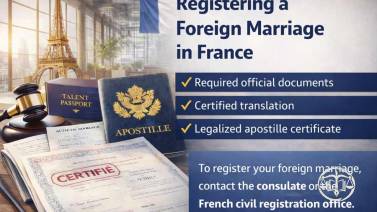
Foreign Marriage Transcription in France: 2026 Guide
How do you transcribe a foreign marriage in France? 2026 guide covering certified translation, apostille requirements, and the steps for an accepted application.

Foreign Adoption Recognition in France: Certified Translation & Apostille
Learn how France recognizes a foreign adoption judgment: procedures, exequatur, apostille requirements, and why certified translation is essential from €20/page.
